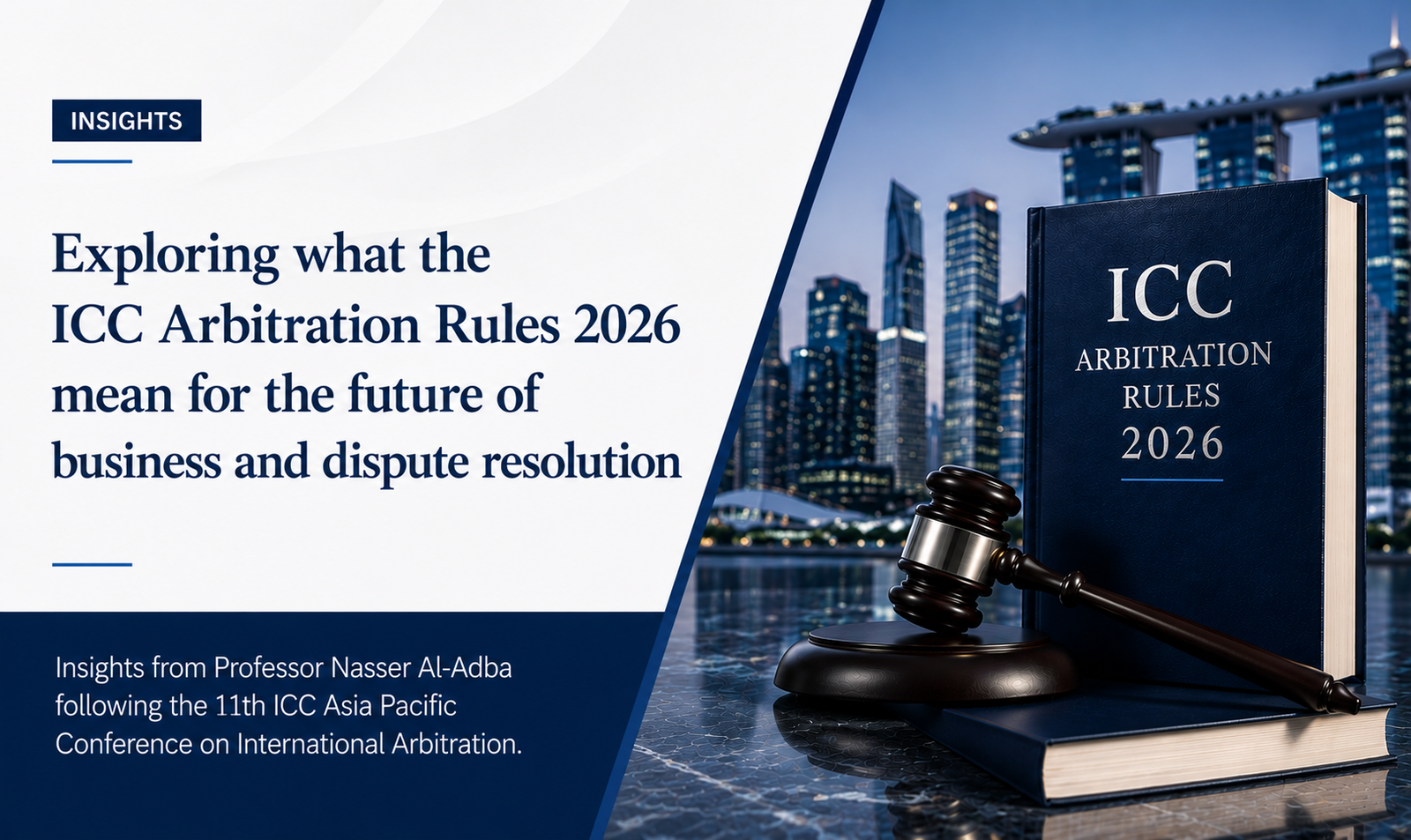
Insights from Professor Nasser Al-Adba following the 11th ICC Asia Pacific Conference on International Arbitration.
The introduction of Article 30 – Early Determination is among the most significant innovations under the ICC Arbitration Rules 2026 and reflects a broader shift towards efficiency, proportionality, and active case management in international arbitration.
As international disputes continue to increase in complexity and value, parties are placing greater emphasis on procedures that allow tribunals to focus on issues that genuinely require determination while avoiding unnecessary cost and delay. The new provision has been introduced to address this challenge by providing a clear procedural framework for the early disposal of claims or defences that are manifestly without merit or manifestly outside a tribunal’s jurisdiction.
These developments formed part of the discussions at the 11th ICC Asia Pacific Conference on International Arbitration in Singapore, which brought together leading arbitrators, practitioners, academics, in-house counsel, and dispute resolution professionals from across the Asia-Pacific region and beyond.
As a Strategic Partner of the conference, Omani & Partners was proud to contribute to these discussions and engage with leading voices in international arbitration. Professor Nasser Al-Adba, Founder, Managing Partner, and Head of Arbitration at Omani & Partners leading the Kingdom of Saudi Arabia, Qatar and United Arab Emirates office practice, joined a panel of international arbitration practitioners to examine the practical implications of Article 30 and its potential impact on the future conduct of arbitration proceedings.
What Is Article 30 Early Determination?
Article 30 introduces an express mechanism allowing arbitral tribunals to dispose of claims and defences at an early stage where they are:
- Manifestly without merit; or
- Manifestly outside the tribunal’s jurisdiction.
Any party may apply for early determination, after which the tribunal has discretion to decide whether the application should proceed and what procedural measures should be adopted.
Historically, arbitral tribunals have relied on inherent procedural powers when faced with clearly unsustainable claims. While such powers were generally recognised, their scope was not always beyond debate. The new provision provides a clear textual foundation for these applications, offering greater certainty to tribunals, counsel, and arbitration users.
Importantly, the mechanism is not intended to permit tribunals to determine disputed factual issues prematurely or dismiss claims simply because they appear weak. Rather, it is aimed at claims and defences that are plainly unsustainable or clearly beyond the tribunal’s jurisdiction.
The Growing Acceptance of Early Determination
The concept of disposing of meritless claims before a full hearing is well established in many legal systems through mechanisms such as summary judgment, strike-out applications, and preliminary jurisdictional determinations.
International arbitration has increasingly embraced similar concepts. Institutions such as the Singapore International Arbitration Centre (SIAC), Hong Kong International Arbitration Centre (HKIAC), and Stockholm Chamber of Commerce (SCC) have introduced procedures enabling tribunals to address clearly unmeritorious claims at an early stage.
The inclusion of Article 30 within the ICC Arbitration Rules 2026 reflects a growing international consensus that tribunals should possess express procedural tools that promote procedural economy, reduce unnecessary expenditure, and improve overall case management.
What Does Article 30 Mean for Businesses and inhouse counsels?
For multinational corporations, government entities, financial institutions, investors, family offices, and private clients involved in international arbitration through their in house legal representatives, the new procedure may provide significant practical advantages.
Large-scale disputes frequently involve:
- Jurisdictional objections;
- Claims that are clearly time-barred;
- Claims directly contradicted by contractual provisions;
- Inflated or abusive claims; and
- Issues capable of determination without extensive evidentiary proceedings.
Historically, parties often incurred substantial legal costs before such issues could be resolved. The updated procedure provides a mechanism that may allow tribunals to address these matters at a much earlier stage.
Potential benefits include:
- Reduced legal costs;
- Faster resolution of disputes;
- Earlier certainty regarding jurisdictional issues;
- More efficient allocation of resources; and
- Greater procedural economy.
These advantages may be particularly valuable in complex cross-border disputes where time, cost, and efficiency are critical commercial considerations.
Balancing Efficiency and Due Procedure
One of the most important themes explored during the panel discussion was the balance between efficiency and the parties’ fundamental right to be heard.
The stipulation is not designed to limit access to justice. Its purpose is to ensure that arbitral resources are focused on disputes that genuinely require determination while avoiding unnecessary expenditure on claims that are plainly unsustainable.
Professor Al-Adba noted that the success of Article 30 will depend largely on how tribunals exercise their discretion in practice. The provision offers substantial benefits, but those benefits must be achieved without undermining fairness, procedural integrity, or the enforceability of awards.
A key challenge will be distinguishing between claims that are merely weak and those that are genuinely “manifestly without merit.” That distinction is likely to become one of the most closely debated aspects of the new Rules.
Other Key Reforms Under the ICC Arbitration Rules 2026
The discussion also explored several other notable developments introduced under the ICC Arbitration Rules 2026.
Among the most significant is the Highly Expedited Arbitration Procedure (HEAP), which is designed to deliver a final award within three months of the Initial Case Management Conference. In appropriate cases, tribunals may issue awards without an oral hearing where the dispute is suitable for determination on a documents-only basis.
The Rules also replace mandatory Terms of Reference with the Initial Case Management Conference, reflecting a broader shift towards active case management and aligning the ICC more closely with contemporary international arbitration practice.
Additional reforms include enhanced arbitrator disclosure obligations, disclosure requirements relating to third-party funding arrangements, and procedural controls governing the introduction of new claims after the commencement of proceedings.
Collectively, these reforms demonstrate the ICC’s continuing commitment to maintaining arbitration as a modern, flexible, and commercially effective method of dispute resolution.
Professor Nasser Al-Adba’s Reflections
Reflecting on the discussions at the ICC Asia Pacific Conference, Professor Al-Adba observed that Article 30 represents an important step in the continued evolution of international arbitration.
In his view, the provision is not simply about disposing of claims more quickly. Rather, it forms part of a broader effort to ensure that arbitration remains proportionate, efficient, and responsive to the needs of modern businesses operating across multiple jurisdictions.
As arbitration users continue to seek faster and more cost-effective methods of resolving disputes, Early Determination may become an increasingly important procedural tool, particularly in complex cross-border disputes where effective case management can significantly influence both cost and outcome.
Conclusion
The ICC Arbitration Rules 2026 mark a significant milestone in the continuing evolution of international arbitration. Among the reforms introduced, Article 30 may prove particularly influential by providing tribunals with an express mechanism to address manifestly unmeritorious claims and jurisdictional objections at an early stage.
As the new Rules begin to be applied in practice, their success will depend on achieving the appropriate balance between procedural efficiency and the parties’ right to be heard – a balance that lies at the heart of modern international arbitration.
About Professor Nasser Mehsin Al-Adba
Professor Nasser Al-Adba is the Founder, Managing Partner and Head of the Arbitration Department at Omani & Partners. He serves as the Immediate Past Chair of the Chartered Institute of Arbitrators (Ciarb), Qatar-QFC Branch, a Court Member of the Organisation of Islamic Cooperation Arbitration Centre (OIC-AC), an ICC ADR Delegate for the MENA region, and a registered arbitrator in the Saudi Center for Commercial Arbitration (SCCA) Court. A highly regarded legal counsel, international arbitrator, and accredited mediator, Professor Al-Adba is also a full-time Assistant Professor of Law at Qatar University. His expertise spans international arbitration, international investment law, construction disputes, public-private partnerships, and complex cross-border commercial matters across the MENA region and beyond.